Skip to content
Cal JiménezCal Jiménez’s Garage & Patio Manuals

A practical manual for concrete, patios, and pavers

Choose the right cleaner before you damage the slab

A dark garage mark, orange ring, or white crust does not call for the same treatment. This manual helps you identify the evidence, make a small compatibility check, use the gentlest workable method, and correct the source when it can be found.

The White Patch Test

PDF

68 pages · 9 chapters · 1 year-round care calendar

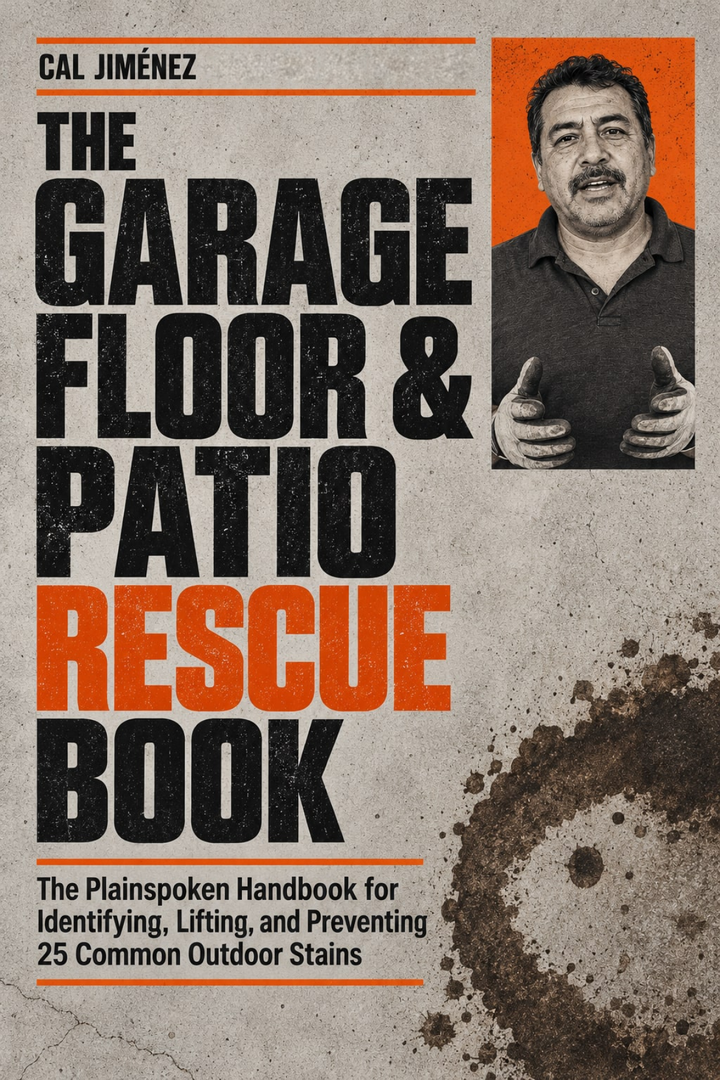
The Garage Floor & Patio Rescue Book

68-page PDF edition

9Chapters
67Pages
$19Your order

Cal Jiménez’s Garage & Patio Manuals

The mark is visible. The cause may not be.

Cleaning harder is not the same as cleaning correctly. Read the color, edge, texture, location, and wet behavior first, then choose a method that respects the surface.

  • An old oil patch beneath the truck stays black after ordinary degreasing because petroleum has traveled into open concrete.
  • Orange rings return beneath an iron plant stand because the metal keeps meeting water, even after the concrete looks clean.
  • A white crust disappears when wet and returns as the slab dries, pointing toward moving moisture and soluble salts rather than ordinary dirt.
  • Patio weeds return each spring because debris and shallow joint gaps keep rebuilding a place for seeds to settle.
  • A pressure wand removes the mark but leaves a pale, rough fan that looks different from the surrounding finish.

The book

The Garage Floor & Patio Rescue Book

The Garage Floor & Patio Rescue Book

The book / 01

The Garage Floor & Patio Rescue Book

The Plainspoken Handbook for Identifying, Lifting, and Preventing 25 Common Outdoor Stains

Identify both the residue and the surface, work on a small hidden area, let it dry, and judge the result before treating the full mark.

The Garage Floor & Patio Rescue Book is a 68-page workshop reference for identifying and treating 25 common outdoor stains. Its 9 chapters begin with stain clues and safe preparation, then move through oil, grease, rust, mineral deposits, leaves, food, algae, paint, tire marks, gum, and pet accidents. You will also find dry-clay and water-based poultice methods, a measured rust-cleaning recipe, paver-joint re-sanding steps, a sealing checklist, and a January-to-December care calendar. Use it when you need to decide what a mark is, what the surface can tolerate, and what observable action should come next.

Selected chapters

  1. Read the Mark Before You Reach for a Cleaner
  2. Test Small, Work Safely, and Protect the Surface
  3. Oil, Grease, Fluids, and the Stains That Sink In
  4. Rust, White Crusts, and Other Mineral Clues
  5. Leaves, Food, Mud, Algae, Mildew, and Moss
  6. Tire Marks, Paint, Sealer Haze, Gum, and Pet Accidents
  7. Clean the Joints and Re-Sand the Pavers
  8. Seal Only When the Surface Is Ready
Selected chapters

Three useful ways into the manual

You do not have to read straight through before using the book. Begin with the task in front of you, then return to the identification and safety chapters before applying a cleaner.

  1. Read the Mark Before You Reach for a Cleaner

    Photograph the mark in daylight, sweep away loose grit, and record its color, texture, edge, location, odor from a safe distance, and response to a light mist of clean water.

  2. Oil, Grease, Fluids, and the Stains That Sink In

    Blot fresh liquid, use dry absorbent, degrease the surface, and reserve a water-based poultice for embedded petroleum. Let the slab dry fully before deciding whether another pass is useful.

  3. Clean the Joints and Re-Sand the Pavers

    Find out whether weeds are rooted in debris, open edges, ant-hollowed joints, or damp moss. Remove contaminated joint material, dry the full depth, refill, compact, clear the paver faces, and activate the sand exactly as labeled.

Look inside

Open a page and read the working method

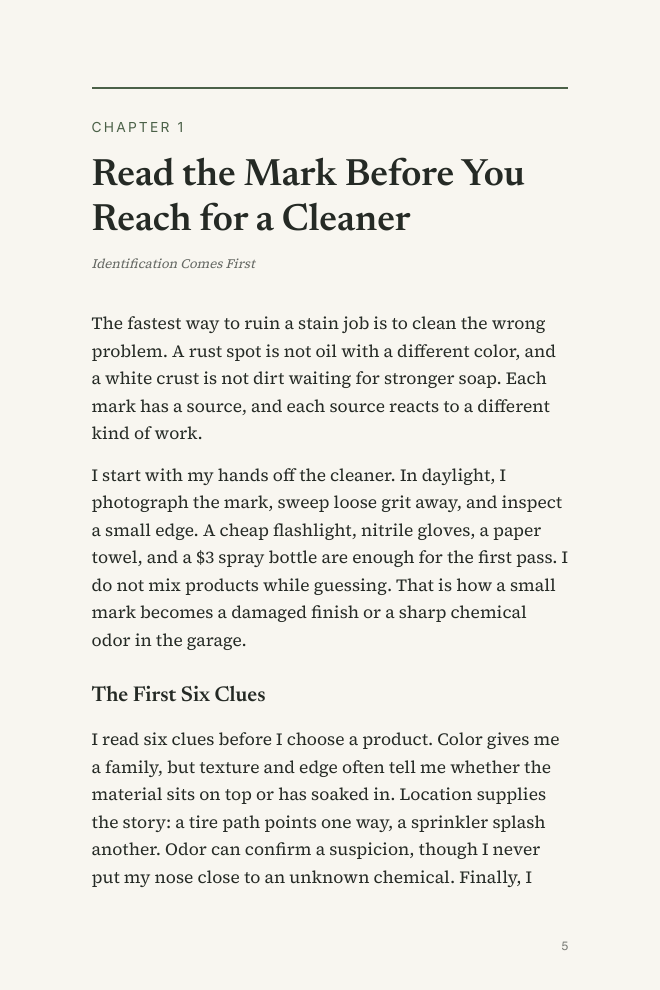
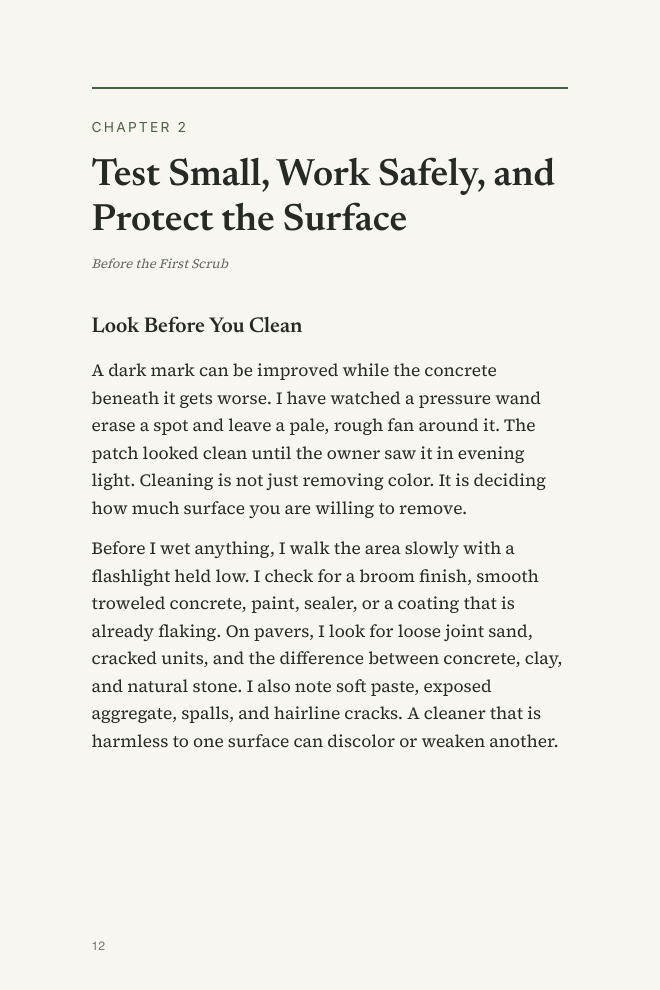
The four interior previews show the book’s practical structure: observable clues, ruled comparisons, warnings, definitions, and numbered actions. You can inspect how Cal sorts stain families, explains concrete porosity, records field evidence, and moves from a small compatibility check to careful cleanup.

68 pages · 9 chapters · 1 year-round care calendar

Page 5 — Read the Mark Before You Reach for a Cleaner
Page 5 — Read the Mark Before You Reach for a Cleaner ↗
Page 12 — Test Small, Work Safely, and Protect the Surface
Page 12 — Test Small, Work Safely, and Protect the Surface ↗
Page 19 — Oil, Grease, Fluids, and the Stains That Sink In
Page 19 — Oil, Grease, Fluids, and the Stains That Sink In ↗
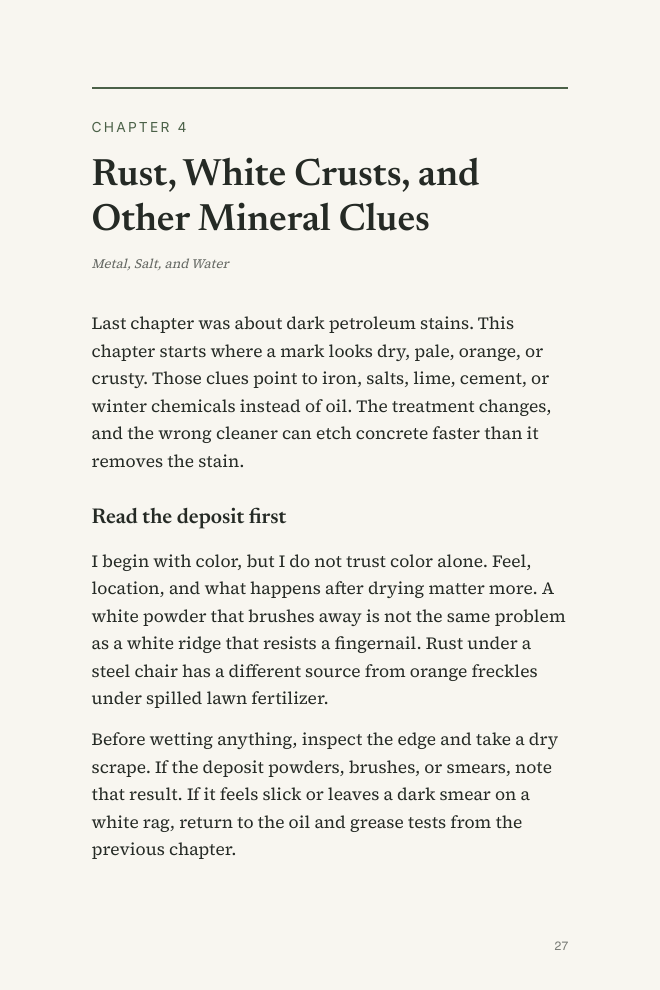
Page 27 — Rust, White Crusts, and Other Mineral Clues
Page 27 — Rust, White Crusts, and Other Mineral Clues ↗
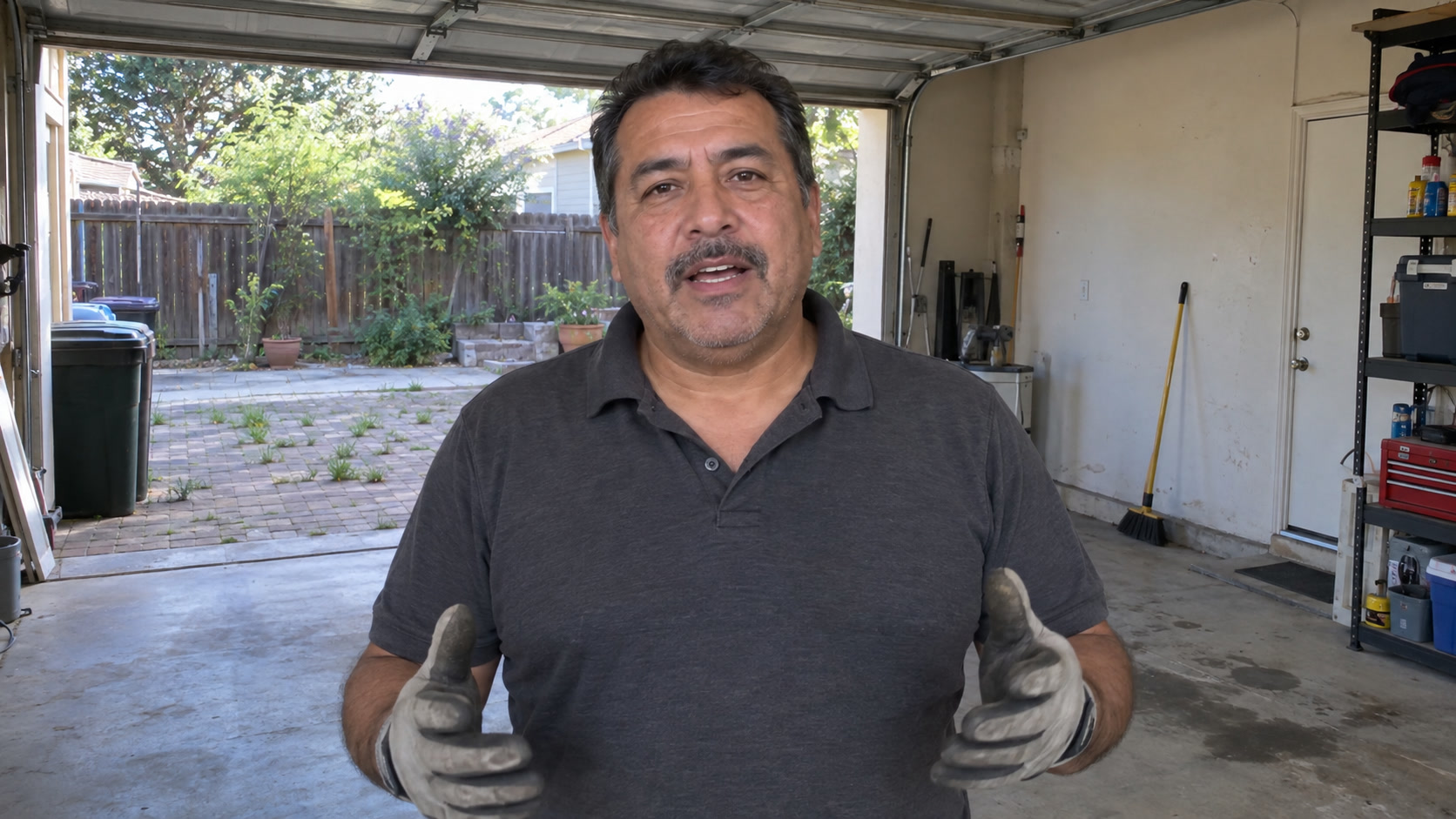
Cal Jiménez

From Cal

Notes from my garage and back patio

I learned to pay attention to concrete while carrying tools for my father, Ernesto, on his San Antonio jobs. I also spent some summers sweeping the floor at my uncle Tomás’s two-bay tire shop. Oil, rubber, dust, and finished slabs leave different evidence, and guessing usually creates more work.

My own garage still carries a faint shadow from an old oil stain that was there when I bought the house. On the patio, I have dealt with recurring paver weeds and three rust rings from Marisol’s black iron plant stand. I favor steady preparation, affordable tools, controlled dwell time, and honest results over a harsh shortcut.

— Cal Jiménez

This is for you if

Who I wrote this for

This is for you if

  • You care for a garage slab, concrete patio, or paver surface and want a clear way to identify common marks before cleaning them.
  • You prefer small compatibility checks, ordinary tools, controlled application, and repeatable maintenance over aggressive first attempts.
  • You want specific help with oil, rust, mineral deposits, organic staining, coatings, paver joints, sealing decisions, and seasonal care.
  • You are willing to inspect drainage, sprinklers, metal feet, leaking vehicles, and joint debris so the source does not immediately replace the stain.

What you get

One manual for the mark in front of you

You receive The Garage Floor & Patio Rescue Book as a 68-page PDF edition. Its 9 chapters cover 25 common outdoor stains, the dry-clay and water-based poultice methods, paver re-sanding, a sealing checklist, and a year-round care calendar.

The Garage Floor & Patio Rescue Book

Your order

The Garage Floor & Patio Rescue Book

$19

68-page PDF edition

68 pages · 9 chapters · 1 year-round care calendar

  • The Garage Floor & Patio Rescue Book · 67 · PDF
Get the PDF $19

7-day money-back guarantee

What you can work toward

What you can work toward

AI-generated illustrations of potential readers.

Make sense of an unknown garage mark

Use color, feel, edge shape, location, odor, water behavior, and surface porosity to sort the mark into petroleum, rust, mineral, organic, coating, or unknown-residue families before selecting a treatment.

AI-generated illustrations of potential readers.

Reduce repeat stains around the patio

Trace rust to wet metal, fertilizer granules, or irrigation; trace white deposits to moisture movement; then change the source. Cal now uses plastic saucers under Marisol’s plant stand and aims sprinkler heads away from concrete.

AI-generated illustrations of potential readers.

Rebuild cleaner paver joints

Diagnose why weeds keep returning, remove contaminated material without undermining the base, allow full-depth drying, and install compatible polymeric sand with proper compaction and label-specific activation.

AI-generated illustrations of potential readers.

Cal Jiménez’s Garage & Patio Manuals

Questions

How is the book organized?

Nine chapters. It opens with reading the mark and testing small and safely, then covers oil and grease, rust and mineral crusts, organic stains, tire marks, paint, gum and pet accidents, paver joints and re-sanding, sealing, and a year-round care calendar.

Do I need experience cleaning concrete or pavers?

No prior trade experience is assumed. The book begins with visible clues and a small hidden-area check, then explains preparation, cleaner compatibility, dwell time, agitation, rinsing, drying, and reassessment in plain language.

Which surfaces does the book discuss?

The guidance addresses open and sealed concrete, garage slabs, patios, concrete pavers, joint sand, paint, sealer, and other coatings. It repeatedly asks you to identify the surface before deciding how much water, pressure, agitation, or cleaner it can tolerate.

What kinds of stains are covered?

The 25 common outdoor stains include motor oil, cooking grease, transmission fluid, fuel residue, rust, fertilizer marks, furniture-foot rust, mineral deposits, leaf tannins, berries, coffee, wine, food grease, grill soot, mud, algae, mildew, moss, tire marks, paint, sealer haze, gum, and pet accidents.

Does it cover deeply embedded oil?

Yes. The oil chapter compares dry-clay absorption with a water-based poultice and maps the sequence from blotting and surface degreasing through drying and reassessment. Cal explains how an old black garage stain improved to a faint shadow rather than claiming that one pass erased it.

Does the book explain how to handle patio weeds?

Yes. It explains why repeated spraying can leave the joint conditions unchanged, then covers weed and debris removal, full-depth drying, compatible polymeric-sand placement, compaction, surface clearing, and activation according to the product label.

What safety guidance is included?

The book covers ventilation, skin and eye protection, plant and metal protection, runoff control, clean rinse water, safe waste collection, and product-label directions. It says never to combine bleach with acids, ammonia, or unknown cleaners, and Cal does not recommend spreading solvent-based poultices in a closed garage.

What format will I receive?

This product is available as a PDF edition. The book is 68 pages long and contains 9 chapters.

Is there a guarantee?

Yes, a 7-day money-back guarantee. Questions or a refund? Just reply to the purchase email you got from Hotmart. A real person answers.

Start with the evidence, not the strongest bottle

Look at the mark in daylight, sweep the grit away, and note what changes when one edge meets clean water. Once you know the likely stain family and surface, the next sound action becomes much easier to choose.

Get the PDF $19

PDF